One visitor to Joshua Creek Heritage Art Centre admitted online that she had lived in the area for more than thirty years and driven past the property more times than she could count on her way to somewhere else. She had never once turned in. When she finally did, on what she called a whim, she found a working farmhouse from 1827, a converted barn full of paintings, and the Centre's founder, who had built the place herself.
That story is not unusual here. The Centre sits on Burnhamthorpe Road East, tucked into a stretch of Joshua Creek that most residents associate with commuting rather than culture. It has no marquee, no parking lot visible from the road, and a schedule that most people only discover by accident. Which is exactly the point of writing about it now. The gallery changes what is on its walls every six to eight weeks, according to a volunteer who once gave a visitor an impromptu tour of the space, so the version of this place you have driven past all summer is not the version you would find if you walked in this week.
A Working Farm Hiding in a Subdivision
The address is 1086 Burnhamthorpe Road East, a 12-acre parcel that predates most of the streets around it by well over a century. The house and barn date to 1827. One reviewer, reflecting on the pace of development along the corridor stretching from Oakville into Milton, called the site a welcome piece of "no-build" ground amid the construction closing in from both directions. Whatever the exact zoning language, the practical effect is the same for anyone who lives nearby: a stretch of open valley and mowed grass that has not been touched by the housing construction bookending the rest of Burnhamthorpe Road.
Here is what you need to know if you want to see it for yourself.
| Detail | Information |
|---|---|
| Address | 1086 Burnhamthorpe Road E, Oakville |
| Hours | Tuesday to Sunday, 1:00 to 4:00 p.m. (closed Mondays) |
| Admission | Free to walk in, donations welcomed |
| Phone | (905) 257-4730 |
| Labyrinth | 1.4 km in, 1.4 km out, open during gallery hours |
The Woman Who Built It
The founder is Sybil Salvin Rampen, raised in a family with United Empire Loyalist roots. By her own account, she grew up hearing stories of earlier generations while sitting near a gas lamp, and that early exposure to oral history became the reason she spent her adult life protecting this one small piece of it. Visitors who happen to catch her there describe someone who will walk you through the studio herself and tell you which pieces on the wall belong to her family.
One visitor who toured the barn on a bright fall day put it simply: Sybil is a "spunky, creative soul." That is a fair summary of a woman who, by multiple accounts, helped her own family build the barn gallery from the ground up rather than commissioning it out.
What the Members' Show Actually Looks Like
The Centre runs a co-op model, meaning the art on display comes from working members rather than a rotating slate of visiting shows booked through a gallery circuit. Each summer, the members' exhibit becomes the showcase for that work. One recent edition featured pieces such as Matthew Morgan Garby's "The Sewing Lesson," Michelle Chen's "Rose Wine," Bhumika Varma's "Poppy Pods in Space," and Kimberly Bell Schols' "Flight of the Lake Dancers," a lineup that gives a sense of how personal and varied the member roster gets from one show to the next. Past visitors have also mentioned watercolor work from Sheridan College students hanging alongside the members' pieces, a detail that gives the space a rotating mix of student and established local artists rather than one static collection.
The turnover matters more than it sounds. A gallery that changes every six to eight weeks is not a place you check off a list once. It is a place that rewards the person who lives five minutes away and stops in on a random Tuesday afternoon between errands, because the walls will not look the same as they did last month.
The Walk You Didn't Know Was Fifteen Minutes Away
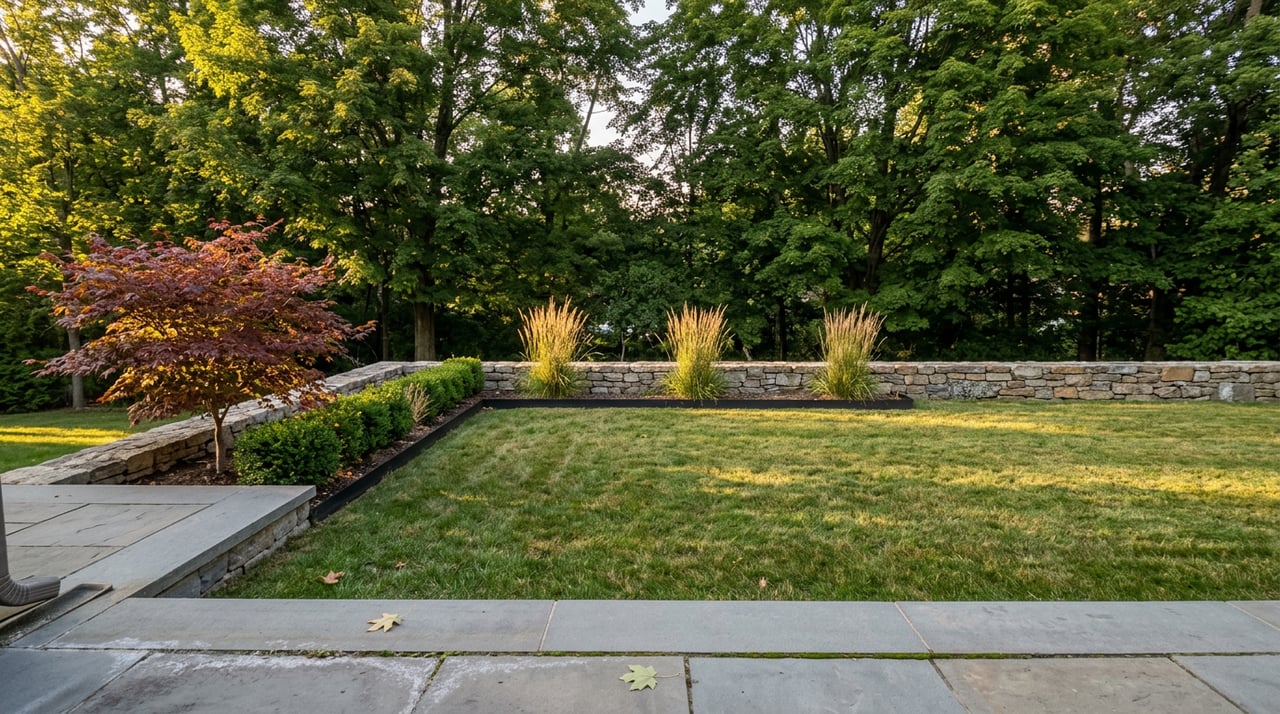
Behind the gallery, the Centre maintains a labyrinth built in partnership with a local organization called Evolving Families. It is modeled on the eleven-circuit design found at Chartres Cathedral in France, laid out on mowed grass rather than the cathedral's stone floor, and it runs 1.4 kilometers in and the same distance back out along a single path. It is open to anyone visiting during gallery hours, free of charge, and it asks for nothing more than a slow pace and a willingness to walk a shape rather than a straight line.
It is an odd thing to find behind a converted barn in suburban Oakville, and that oddity is part of the appeal. Most neighborhood walking routes follow a creek or a park loop. This one follows a centuries-old pattern designed for reflection, sitting less than a mile from some of the busiest stretches of Ninth Line and Burnhamthorpe.
The Library Nobody Mentions
Tucked inside the gallery is a small research library that most visitors walk past on their way to the paintings. It holds two named collections: the Amice Calverley collection and the David Horne architecture library. Both are described by the Centre as available for research use, which makes this one of the few places in the neighborhood where a genuine reference archive sits open to the public rather than locked behind an institutional door. It will not be for everyone. For anyone with an interest in architecture or regional history, it is the kind of detail that turns a casual visit into a longer one.
A Calendar Built Around Making Things
The Centre's programming leans toward hands-on work rather than passive viewing. Recent workshop offerings have included watercolor printmaking and something the Centre calls its "fix-it garage," alongside seasonal events that have become part of its regular rhythm: a Spring Handmade Market with a modest two-dollar admission supporting local artisans, an Easter craft and egg decorating workshop that blends art with simple science activities for kids, a Gluten-Free Bazaar built around local vendors and community awareness, and an open-air concert called "In the Open Air" that has paired the Centre with the Intrada Brass of Oakville for an evening of music on the grounds.
None of these are one-time stunts. They are the kind of recurring calendar that a volunteer-run, donation-supported venue builds over years, which means the specific dates shift from one year to the next but the pattern holds. If you want to catch one, the Centre's own events page is the most reliable place to check what is coming up before you plan a visit.
Why This Is Worth Your Saturday
The obvious version of this story is "there's an art gallery near you." The more useful version is that Joshua Creek has a piece of protected, uncleared land in the middle of a corridor being built out on both sides, run entirely by volunteers, holding a rotating exhibit that changes roughly eight times a year, a meditation walk modeled on a French cathedral, and a small research library most people never learn exists. None of that requires a special occasion. It requires walking in the door you have already driven past.
The Centre operates as a registered charity, and its own charity profile lays out its mission in more detail if you want the fuller picture before you go. Bring cash for a donation, plan for the Tuesday-through-Sunday afternoon window, and give yourself time to walk the labyrinth before you leave.
If Joshua Creek is your neighborhood and you want more of the local detail that doesn't show up on a listing sheet, from what's changing at the parks to what's opening down the road, Rina DiRisio and her team spend as much time tracking the texture of this area as they do the market itself. Reach out any time you want a local read on what's happening around you.
This article is general information, not legal, tax or financial advice. Consult a qualified professional about your situation.
